In today’s rapidly evolving digital payment ecosystem, recurring payments have become an essential part of industries such as lending, insurance, banking, utilities, subscriptions, and financial services. Businesses are increasingly adopting automated collection systems to improve payment consistency, reduce follow-ups, and create smoother customer experiences.
However, despite the rapid growth of digital payment solutions, paper mandates continue to hold significant importance in recurring payment collections.
While paper mandates are often associated with Tier 2 and Tier 3 markets, the reality is far broader. Even many Tier 1 businesses continue to rely heavily on physically collected mandates especially organizations managing high-volume onboarding, branch-based operations, assisted customer journeys, and field collections at scale.
For businesses today, the challenge is no longer choosing between digital and paper mandates. The real challenge lies in managing paper mandates efficiently without increasing operational complexity.
The Reality of Paper-Based Onboarding
As businesses expand their recurring payment operations, onboarding volumes continue to rise. Despite increasing digital adoption, many customers still prefer or depend on physical documentation during the onboarding process.
Paper mandates remain widely used across:
- Assisted onboarding environments
- Banking and financial services
- Insurance and lending sectors
- Field collection operations
- Branch-based customer onboarding
- Customers with limited digital accessibility or awareness
In many cases, paper mandates continue to provide a more practical and accessible onboarding experience for both businesses and customers.
However, traditional paper mandate processing often creates operational inefficiencies when handled manually especially at scale.
Common Challenges in Manual Mandate Processing
Delayed Onboarding & Activation
Physically collected forms often pass through multiple stages of verification and processing, resulting in slower customer onboarding and delayed mandate activation.
High Operational Dependency
Manual form handling, data entry, and verification increase dependency on operations teams and field staff, making the process resource-intensive.
Increased Chances of Errors
Incorrect utility codes, incomplete information, mismatched frequencies, and manual data entry errors can lead to mandate rejections and processing delays.
Limited Workflow Visibility
Tracking the status of physical mandates across teams and workflows becomes difficult without a centralized system.
Slower Recurring Collections
When mandate activation is delayed, recurring collections are impacted affecting collection efficiency, customer experience, and business cash flow.
As onboarding volumes increase, these challenges become even more difficult for businesses to manage manually.
Why Paper Mandates Still Matter
Despite the operational challenges, paper mandates continue to play a critical role in recurring payment collections for several reasons.
Accessibility Across Customer Segments
Not every customer is comfortable with completely digital onboarding journeys. Paper mandates help businesses serve wider customer groups more effectively.
Practical for Assisted & Field-Based Operations
For organizations operating through branches, agents, relationship managers, or on-ground sales teams, paper-based onboarding remains a reliable and familiar process.
Better Customer Confidence
In financial onboarding journeys, many customers still feel more secure signing physical documents during consent and authorization processes.
Supports Large-Scale Collection Operations
Even digitally advanced businesses often continue using paper mandates to manage large onboarding volumes across multiple operational channels.
This is why businesses should not focus on eliminating paper mandates completely but instead modernize the way they manage and process them.
The Smarter Approach to Paper Mandate Management
Modern recurring payment solutions are helping businesses transform traditional paper mandate processing into a faster, smarter, and more scalable workflow.
Instead of treating paper mandates as an operational bottleneck, businesses can streamline the entire onboarding journey through smarter processing systems.
This includes:
- Pre-filled mandate forms for faster onboarding
- Smart scan and image capture of manually filled forms
- Auto-ready templates for utility code, frequency, and mandate details
- Reduced manual effort and operational dependency
- Improved processing accuracy and workflow visibility
- Faster mandate activation for seamless recurring collections
By simplifying paper mandate management, businesses can improve onboarding efficiency while continuing to support customers who rely on physical documentation.
How Paycorp Simplifies Paper Mandate Processing
At Paycorp, we help businesses modernize recurring payment collections through smarter mandate onboarding solutions designed for both digital and paper-based journeys.
Our Paper Mandate solution enables organizations to simplify physically collected mandate processing through a more structured, efficient, and scalable workflow.
With capabilities focused on onboarding efficiency, operational accuracy, and faster activation, businesses can reduce manual effort while improving collection readiness at scale.
Whether it is for banking, lending, insurance, or field-based onboarding environments, Paycorp helps businesses create a smoother recurring payment experience without disrupting existing operational processes.
Conclusion
Paper mandates are far from outdated. In fact, they continue to remain an important part of recurring payment collections across multiple industries and customer segments.
The key is not replacing paper mandates entirely but managing them more intelligently.
By modernizing paper mandate onboarding workflows, businesses can reduce operational burden, improve onboarding speed, and create more efficient recurring collection processes at scale.
As recurring payment ecosystems continue to evolve, organizations that simplify and streamline paper mandate processing today will be better positioned to scale efficiently tomorrow.
FAQ
What is a paper mandate in recurring payments?
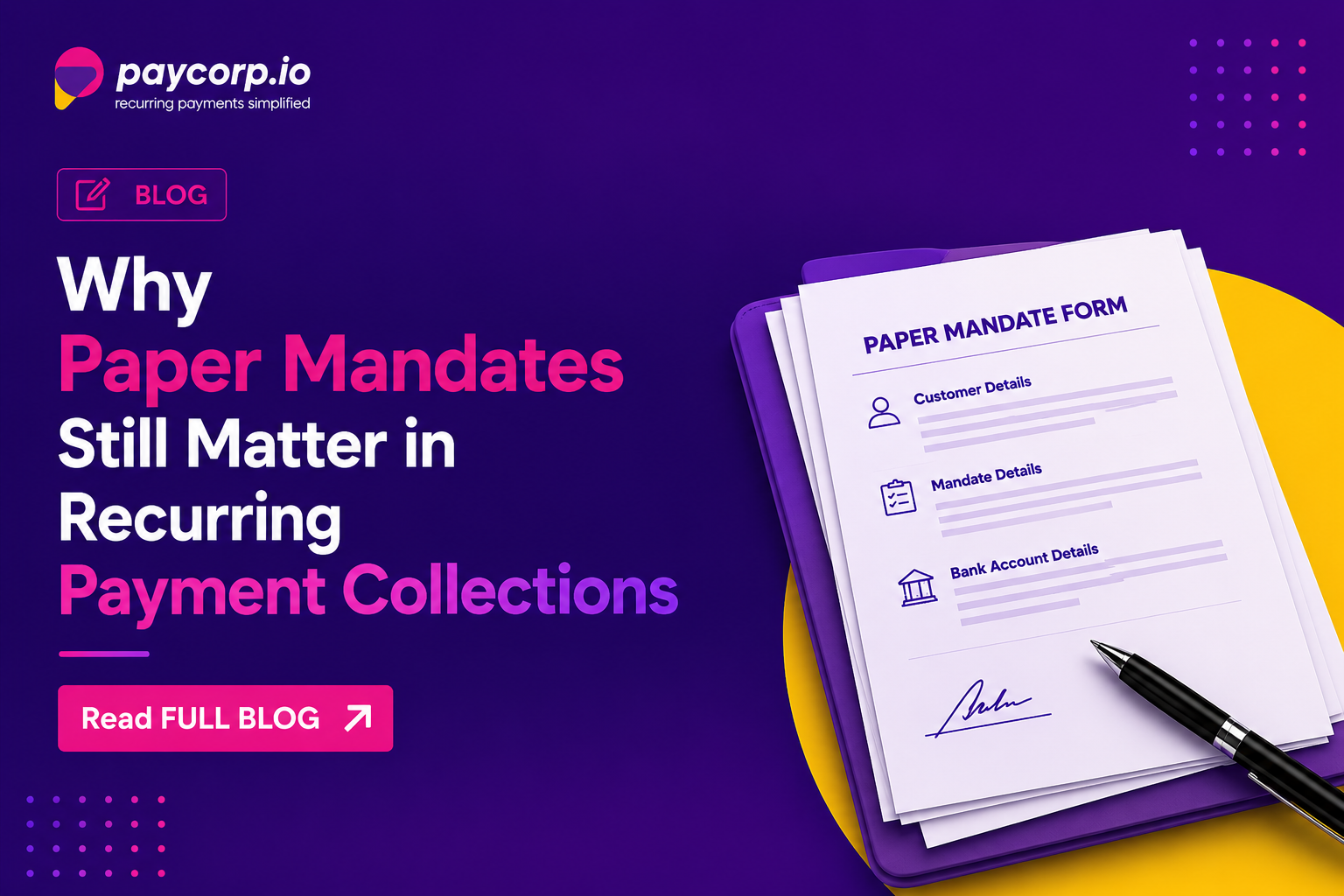
A paper mandate is a physical authorization form signed by customers to allow businesses to collect recurring payments automatically from their bank accounts.
Why are paper mandates still important in recurring payment collections?
Paper mandates remain important for businesses handling assisted onboarding, branch-based operations, field collections, and customers with limited digital accessibility.
What challenges do businesses face in manual paper mandate processing?
Common challenges include delayed onboarding, manual errors, operational dependency, slower mandate activation, and limited workflow visibility.
How can businesses simplify paper mandate processing?
Businesses can simplify paper mandate processing through pre-filled forms, smart scan capture, centralized workflows, automated validation, and faster onboarding systems.
Which industries still use paper mandates?
Industries such as banking, NBFCs, insurance, lending, utilities, and subscription-based businesses continue to use paper mandates for recurring payment collections.
What is mandate onboarding?
Mandate onboarding is the process of registering customer authorization for recurring payment collections through digital or paper-based mandates.
How do paper mandates support recurring collections?
Paper mandates help businesses onboard customers efficiently, especially in assisted or field-based environments, enabling smoother recurring payment collections.
How can businesses reduce errors in paper mandate processing?
Businesses can reduce errors by using structured templates, auto-ready utility codes, centralized processing systems, and smart verification workflows.
What are the benefits of modern paper mandate management?
Modern paper mandate management improves onboarding efficiency, reduces manual effort, increases processing accuracy, and supports faster mandate activation.
How does Paycorp simplify paper mandate onboarding?
Paycorp simplifies paper mandate onboarding through smarter workflows, pre-filled mandate forms, scan-based processing, and improved operational visibility for recurring payment collections